Return Journey
The Return Journey marks the closing movement of Bilbo Baggins's great adventure, a phase in which the hero, having survived the Battle of Five Armies and witnessed the death of Thorin Oakenshield, must reckon with loss, accept a modest reward, and make his way back to the Shire—only to discover that home itself has become strange. It is a journey not merely across miles but across the gap between the person he was and the person he has become.
Aftermath and Farewell
Bilbo awoke alone on the flat stones of Ravenhill, his head burning with pain and his body chilled. Looking into the valley, he saw no living goblins, only the still aftermath of battle: a camp in the plain, dwarves busy removing the wall at the Gate, and a sorrowful silence hanging in the air. A man sent by Gandalf found him, for the wizard had noted that Bilbo's voice was last heard on that height. Carried down to a tent in Dale, Bilbo was brought before Thorin Oakenshield, who lay wounded with many wounds, his rent armour and notched axe cast upon the floor. Thorin spoke his farewell: "Farewell, good thief," he said. "I go now to the halls of waiting to sit beside my fathers, until the world is renewed. Since I leave now all gold and silver, and go where it is of little worth, I wish to part in friendship from you, and I would take back my words and deeds at the Gate." Bilbo knelt, filled with sorrow, and replied, "Farewell, King under the Mountain! This is a bitter adventure, if it must end so; and not a mountain of gold can amend it. Yet I am glad that I have shared in your perils—that has been more than any Baggins deserves." Thorin answered with a final reflection: "There is more in you of good than you know, child of the kindly West. Some courage and some wisdom, blended in measure. If more of us valued food and cheer and song above hoarded gold, it would be a merrier world. But sad or merry, I must leave it now. Farewell!" Bilbo turned away and wept until his eyes were red and his voice hoarse. He later said to himself, "I wish Thorin were living, but I am glad that we parted in kindness."
The Division of the Hoard and the New Order
Thorin was buried deep beneath the Mountain, and Bard laid the Arkenstone upon his breast, saying, "There let it lie till the Mountain falls! May it bring good fortune to all his folk that dwell here after!" Upon his tomb the Elvenking laid Orcrist, the elvish sword that had been taken from Thorin in captivity; it is said in songs that it gleamed ever in the dark if foes approached, so that the fortress of the dwarves could not be taken by surprise. Dain son of Nain became King under the Mountain, and in time many other dwarves gathered to his throne in the ancient halls. Of Thorin's twelve companions, ten remained; Fili and Kili had fallen defending him with shield and body, for he was their mother's elder brother. The others stayed with Dain, who dealt the treasure well. A fourteenth share of all the silver and gold, wrought and unwrought, was given up to Bard, for Dain said, "We will honour the agreement of the dead, and he has now the Arkenstone in his keeping." Even that single share was wealth exceeding that of many mortal kings. From it Bard sent much gold to the Master of Lake-town, rewarded his followers and friends freely, and gave to the Elvenking the emeralds of Girion, which Dain had restored. To Bilbo, Bard offered a rich reward, but the hobbit refused most of it. "How on earth should I have got all that treasure home without war and murder all along the way, I don't know," he said. "And I don't know what I should have done with it when I got home. I am sure it is better in your hands." In the end he accepted only two small chests, one filled with silver and the other with gold, such as one strong pony could carry.
The Road Home
Bilbo said his farewells to the surviving dwarves—Balin, Dwalin, Dori, Nori, Ori, Oin, Gloin, Bifur, Bofur, and Bombur—and to the memory of Thorin, Fili, and Kili. The dwarves bowed low before their Gate, and Balin said, "Good-bye and good luck, wherever you fare! If ever you visit us again, when our halls are made fair once more, then the feast shall indeed be splendid!" Bilbo replied, "If ever you are passing my way, don't wait to knock! Tea is at four; but any of you are welcome at any time!" Then he turned away. The elf-host was on the march, and Gandalf and Bilbo rode behind the Elvenking, with Beorn striding beside them in man's shape, laughing and singing. They travelled along the northern edge of Mirkwood, a long and cheerless road, but safer now that the goblins were crushed. At the borders of the forest, Bilbo gave the Elvenking a necklace of silver and pearls, saying, "I thought that, er, some little return should be made for your, er, hospitality. I mean even a burglar has his feelings. I have drunk much of your wine and eaten much of your bread." The king accepted the gift, named Bilbo elf-friend and blessed, and bade him farewell. The journey continued with Gandalf and Beorn for much of the way. By midwinter they reached Beorn's house, where Yule-tide was warm and merry; men came from far and wide to feast. In spring, Bilbo and Gandalf took their leave of Beorn, and Bilbo left with regret, for the flowers of Beorn's gardens in springtime were no less marvellous than in high summer. At last they came to the High Pass where the goblins had captured them before. Looking backward, Bilbo saw Mirkwood blue in the distance and the Lonely Mountain on the edge of eyesight, its highest peak still gleaming with unmelted snow. "So comes snow after fire, and even dragons have their ending!" he said, and turned his back on his adventure. "I wish now only to be in my own armchair!"
Homecoming and Transformation
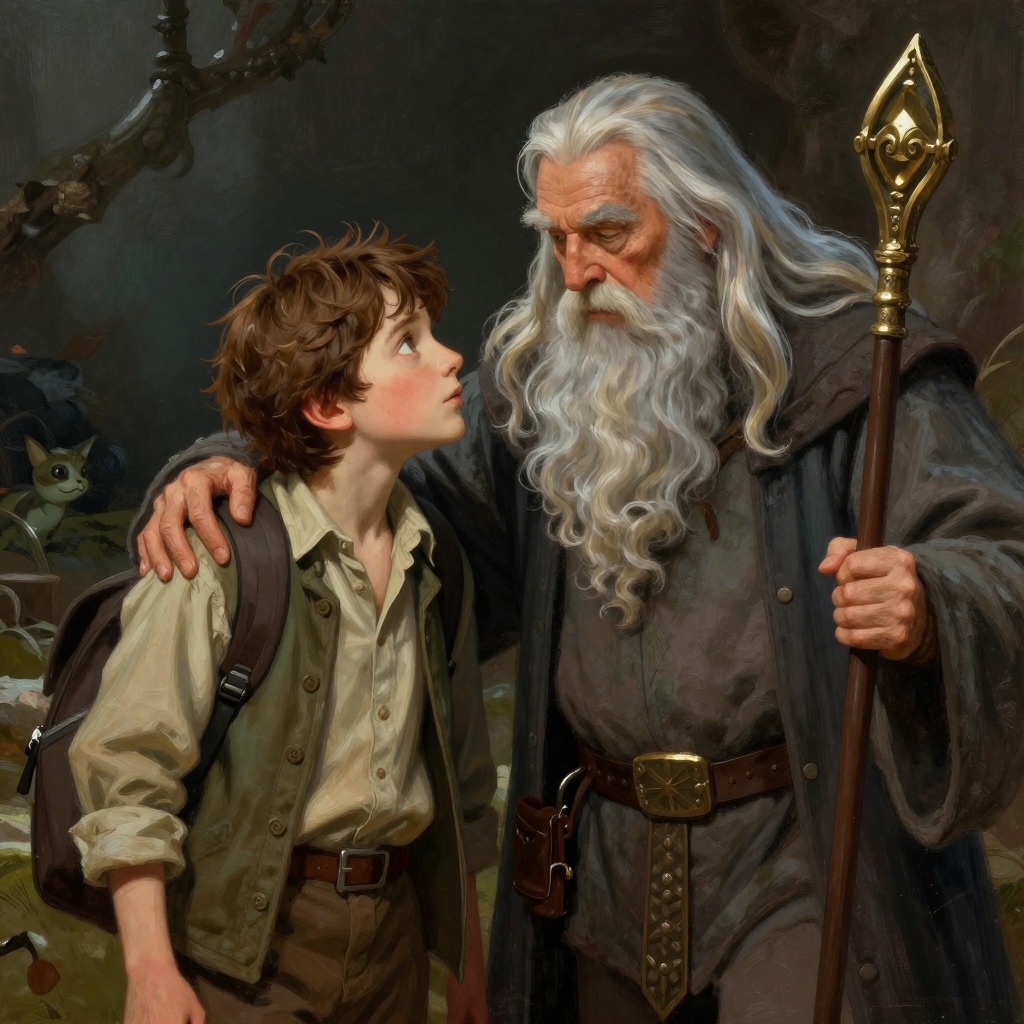
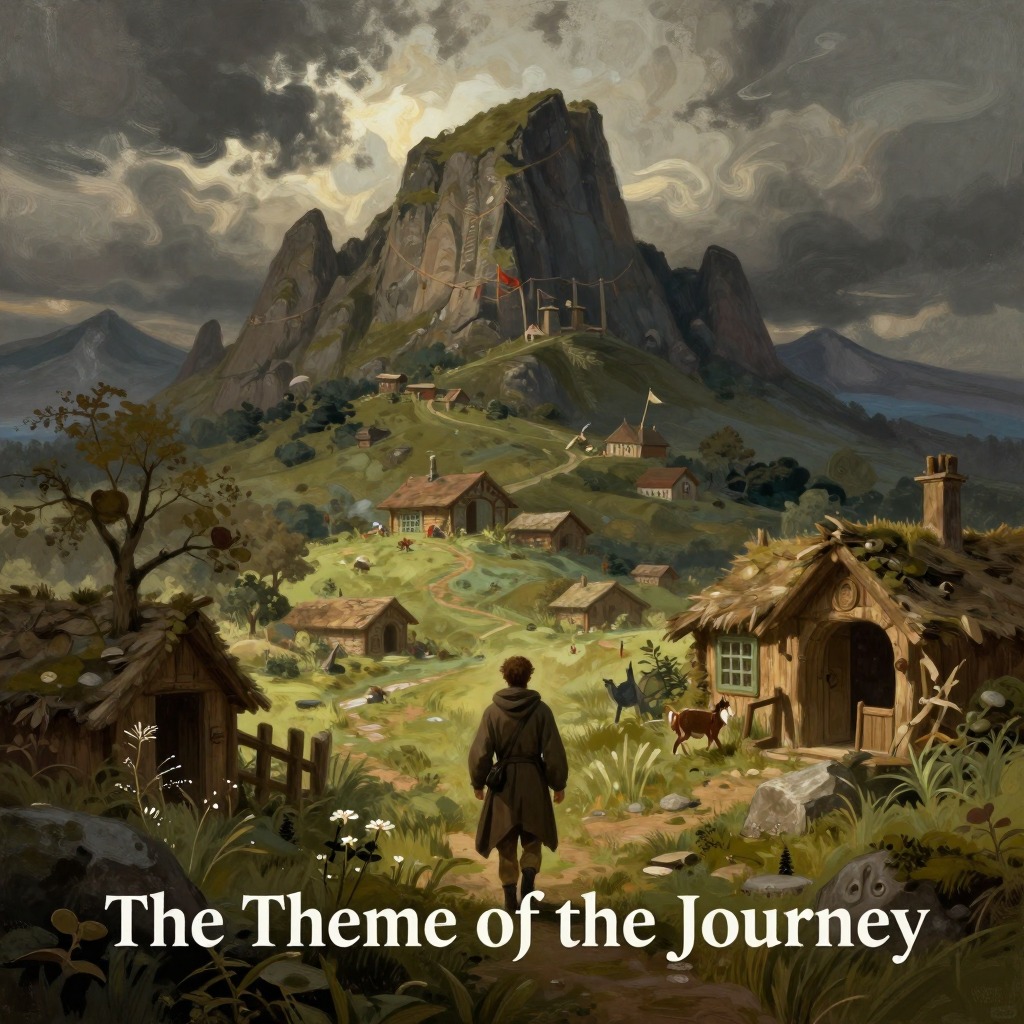
On May the First, Bilbo and Gandalf came to Rivendell, where they were welcomed by Elrond and the elves. There Bilbo learned that Gandalf had been to a great council of the white wizards, who had driven the Necromancer from his dark hold in the south of Mirkwood. After a week of rest, Bilbo rode on with Gandalf. They crossed the ford at the edge of the Wild, found the gold of the trolls still hidden and untouched, and Bilbo insisted that Gandalf take it, saying, "I have enough to last me my time." They pressed on through June, and at last came within sight of the Hill. Bilbo stopped and recited a verse: "Roads go ever ever on, / Over rock and under tree, / By caves where never sun has shone, / By streams that never find the sea; / ... / Yet feet that wandering have gone / Turn at last to home afar." Gandalf looked at him and said, "My dear Bilbo! Something is the matter with you! You are not the hobbit that you were." They crossed the bridge, passed the mill, and came to Bilbo's own door—only to find a large notice announcing the auction of the effects of the late Bilbo Baggins. His cousins the Sackville-Bagginses were busy measuring his rooms. Bilbo had to buy back much of his own furniture, and many of his silver spoons mysteriously disappeared. He found he had lost more than spoons: he had lost his reputation. He was no longer quite respectable; the hobbits of the neighbourhood held him to be 'queer.' Yet he did not mind. He was quite content. The sound of the kettle on his hearth was ever after more musical than it had been before the Unexpected Party. His sword he hung over the mantelpiece; his coat of mail was arranged on a stand in the hall; his gold and silver was largely spent in presents. His magic ring he kept a great secret, using it chiefly when unpleasant callers came. He took to writing poetry and visiting the elves, and though few believed his tales, he remained very happy to the end of his days, and those were extraordinarily long. One autumn evening some years later, Gandalf and Balin visited him, and they talked of the lands of the Mountain, now prosperous and at peace. Bilbo had come home, but home itself had changed—and so had he.